Want this info every week by text? I send a text every Friday with current market and rate data. Text “add me to the weekly rate update” to my cell at 619-300-2800 if you want to be added to my weekly rate/market update text.
What’s Happening?
All news below is color-coded as “good“, “bad“, or “neutral” for mortgage rates.
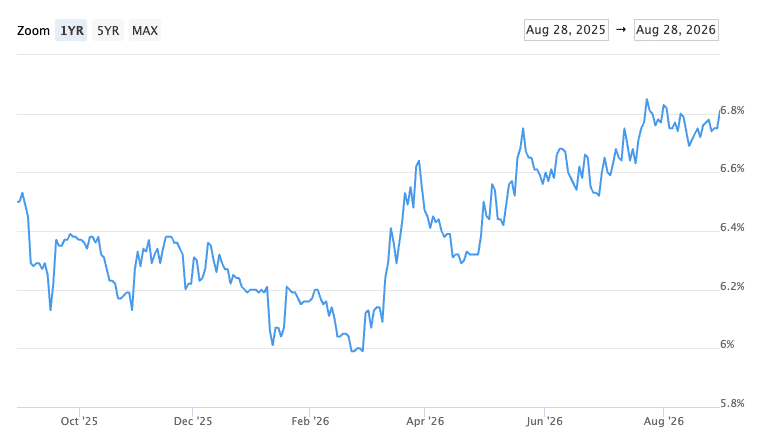
Summary: Rates slowly march higher as oil remains elevated and economic data supports rate increases. Lasting peace with Iran or a drop in inflation (or both) are what we’re collectively holding our breath for.
•Geopolitics (bad for rates): News with Iran has become relatively quiet, as this latest war site in a stalemate. I’m seeing no reports of any ongoing peace talks between the US and Iran.
•Brent Crude Oil Prices (bad for rates): Along with the Iran war, the price of Brent Crude has also stalled and has been oscillating in the approximate $90/barrel range.
Brent Crude $USD/Barrel – 8/28/2026
•US Bond Market (bad for rates): Long-dated (10-30 year) US Treasury Bond yields have surged, which means bond prices are falling. Surging bond yields tends to push other borrowing rates up, including mortgage rates.
In response, Treasury Secretary Scott Bessent announced that the Treasury would at least double its long-term (10- to 30-year) bond purchases, currently at $2 billion per week, to $4 billion per week. The 30-year US Treasury Bond hit a near 20-year high of 5.33% on August 17th, has remained elevated, and sits at 5.213% as of August 28th. The bond market responds to a number of things, among them, inflation expectations. When long-term bonds rise, that predicts that inflation is rising. Interest rates naturally rise to match the future expected value of the money that will be used to repay a debt. The move hasn’t been drastic, but it’s piled on top of the other tiny moves up over the last several months.
Demand for bonds helps lower bond prices (and related interest rates, like mortgage rates). The Treasury increasing its bond repurchases should help to pull rates down a bit, and it did, for about a day LOL, but quickly rebounded. Long term, this is a strategy governments can use to help control interest rates and is something we’ll likely see more of. Rates have stabilized (but not dropped) since this Treasury announcement.
The 30-year Treasury bond last broke above 5% in October 2023 when conventional mortgage rates briefly touched 8%. Rates quickly fell. The 30-year bond again broke 5% after the Iran war started in March of this year, and has been bouncing above and below 5% since then. In July it rose to 5.2% and has remained in that range for all of August.
•Inflation Report (good for rates): The latest CPI (inflation) report for July reports annual consumer inflation at 3.4%. June’s year-over-year was 3.5%, and May’s was 4.2%. This is not a downward trend in prices, but rather a less steep upward trend. Still, this signals slightly positive news for mortgage rates. Slightly falling oil prices are the main driver of the slightly less inflation we’ve seen over the past 2 months. Oil sat above $100/barrel for much of March, April, and May and is now in the $90 range. Compare that to <$70 before the Iran war started in March.
•Jobs Report (good for rates): The July BLS jobs report showed a net job loss of -23k jobs in July. May and June jobs numbers were revised down by 66k and 37k.
•Unemployment Metric (bad for rates): Unemployment dropped to 4.1%, compared to 4.2% in June and 4.3% in May. Unemployment dropping alongside negative new jobs might seem counterintuitive, but that means that means 2 things: jobs are disappearing, and people are dropping out of the workforce and therefore are no longer counted in the unemployment number, which looks at adults seeking work but unable to find it. If you’re not seeking employment (like retired or having given up), you’re not counted in the unemployment figure. Falling unemployment shows labor market strength, which can push rates up. The opposing Jobs and Unemployment data points seemed to have balanced each other out in terms of rate effect.
My Predictions
Without Iranian peace, an opened Strait of Hormuz, and falling oil prices, I don’t expect the rate market to get any prettier…
The Bond market is telling the loudest story right now. Prices are an extremely dense piece of data, summarizing the totality of supply, demand, and future projections, and the bond market has long told a story of the inflationary direction that the economy is headed in. The job market remains strong, so that’s something I’m not currently worrying about, but we live in a debt-fueled world where higher prices are an inevitability. Just look at real estate from any time in the last 100 years until now.
And I honestly think this is the best case for purchasing a home and is why we finally bought our first home last summer. Not because it will make us rich, but as a defensive move against inflation. In the long term, all prices will continue to rise on average, from rent to groceries. And mitigating the increase in our cost of housing is the most significant piece of long-term financial stability that we can make. If you bought your house before 2020, then you know what I’m talking about!